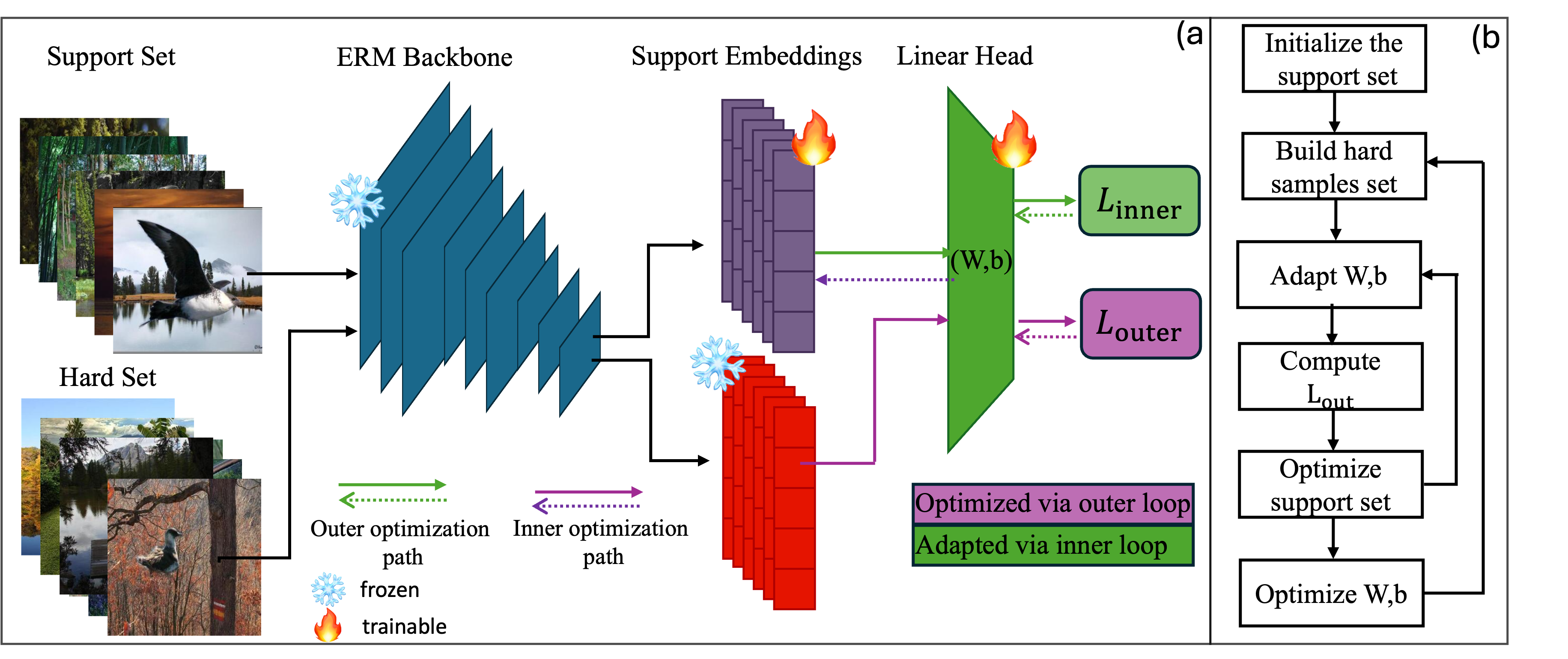
Deep neural networks often rely on spurious features to make predictions, which makes them brittle under distribution shift and on samples where the spurious correlation does not hold (e.g., minority-group examples). Recent studies have shown that, even in such settings, the feature extractor of an Empirical Risk Minimization (ERM)-trained model can learn rich and informative representations, and that much of the failure may be attributed to the classifier head. In particular, retraining a lightweight head while keeping the backbone frozen can substantially improve performance on shifted distributions and minority groups. Motivated by this observation, we propose a bilevel meta-learning method that performs augmentation directly in feature space to improve spurious correlation handling in the classifier head. Our method learns support-side feature edits such that, after a small number of inner-loop updates on the edited features, the classifier achieves lower loss on hard examples and improved worst-group performance. By operating at the backbone output rather than in pixel space or through end-to-end optimization, the method is highly efficient and stable, requiring only a few minutes of training on a single GPU. We further validate our method with CLIP-based visualizations, showing that the learned feature-space updates induce semantically meaningful shifts aligned with spurious attributes.
.jpg)